Ravelinen
In the capital Copenhagen, we have Ravelinen here by Volden in outer Christianshavn, and we have the small gardens in Frederiksberg - below Frederiksberg Castle - all as some very special eateries with history and atmosphere - and both outdoor and indoor serving.
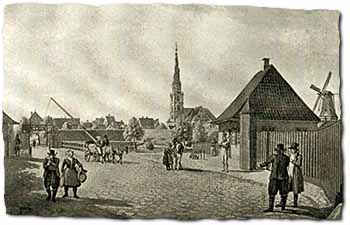 Ravelinen was built in 1728 and is of course listed today. The buildings were originally a kind of toll house and military guardhouse, where guards held back passers-by to check that they had paid the toll when crossing from land to city. Amager was open farmland, and Christianshavn was seen from here as the start of the big city. The name ravelin is French and means "angle-bent outwork between two bastions". If we translate it into a little more modern Danish - it means a kind of advanced fortification between two of Christianshavn's rampart bastions - "Elefantens Bastion" towards the SAS hotel - and "Løvens Bastion" towards Christiania and Holmen. Christian IV had the rampart built around Christianshavn to protect the city from this side as well - and today the rampart is the city's most intact and unspoiled of all outer defenses.
This is where people go for a walk on Great Prayer Day evening. The complex consisted of a series of bastions, and between them shot even more advanced fortifications - slender ravelins - like Ravelinen here. It lay like a small artificial island out in the middle of the moat, which is difficult to understand today, where the road between Amager and Christianshavn has grown large and wide and forces its way through the moat. Previously, there was a small narrow road from Amager to Ravelinen and then from Ravelinen a wooden bridge to Christianshavn. In 1856, the city completely closed the fortress and thus Amagerport, but Ravelinen, the small artificial island, remained, and thus also the house Ravelinen. The arrangement to pay tolls ceased as late as in 1915.
In 1941, the building opened as a restaurant and eatery with a magnificent view of the moat. Since then, some has been added.
Acciseboden
Acciseboden on Christianshavns Vold is located a little further in towards Torvegade than Ravelinen - on the same side of and on the edge of the rampart. It is the very beautiful, small yellow building with the elegantly shaped roof - and with slightly less interesting barracks toilets on the back.
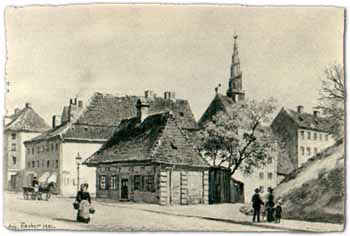 The house is from 1718-20 and is not - despite the name - an excise booth, but was built as a gatekeeper's house or guardhouse while Assiceboden was located further out on Amager, where Amagerbrogade and Markmandsgade flow into Christmas Møllers Plads. Accise is French and means "domestic tax on consumer goods, especially when these were brought to the city", so an excise booth is a kind of city-customs-booth. So accise - or "zise", as it was also called, is a tax. Later it was called consumption, and today this kind of thing is called VAT and is paid directly upon purchase - not when we pass city gates.
When the farmers had to go to the city with goods, they had to pay a tax, and this took place at the acciseboden, which was located further out at Markmandsgade.
Further on with the city, one was then checked at Ravelinen, where guards then checked that one had also paid tax for the goods one had with one, and further in again we find the fine, yellow house, which we today call "Acciseboden", but which is actually only a kind of gatekeeper's house. The booth was previously located further out on the road, but when the road was to be expanded in the 1930s, it was very deftly rolled 10 meters back with the rampart. The actual excise booth at Markmandsgade was from the 1820s. It was later torn down in 1913, but the one we now call Acciseboden is fortunately listed.
Amagerport
Vesterport, Østerport and Nørreport are concepts we know in everyday life in Copenhagen. But Amagerport is used a little less. Copenhagen used to have four city gates, which one had to go through when going in and out of the city. And here the city collected tolls. The gates were pure buildings, but today we only have the names back in Vesterport station, Østerport station and Nørreport station. Since there is no station on Amager, the name has almost disappeared in everyday speech.
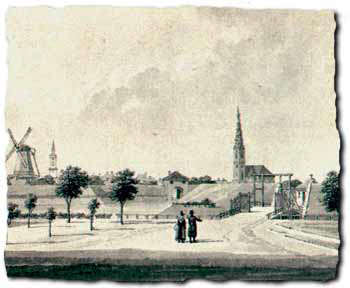 Amagerport was located where Torvegade cuts through the rampart. The first gate was built in 1668, the next came in 1724 and was quite nicely equipped - even mostly towards Amager - with sandstone decorations. Amagerport was the least important of the city's four checkpoints, as this was not the road out to the open country, only to the island of Amager, and only Amager farmers had to go through here.
In 1856, Copenhagen closed its fortress, that is, it gave up having ramparts and defenses around the city, and in this way we got wonderful parks such as Chriatianshavns Vold, which, however, only opened as a recreational area around the turn of the century.
The other old ramparts are Østre Anlæg, Botanisk Have, Ørstedsparken and Tivoli, which together constituted another significant defense complex around the city with the three city gates. (Such a city gate can still be experienced today in Stege, where they have managed to preserve it, even though it is actually a nuisance for today's traffic). In 1920, Copenhagen's road authorities had kilometer stones erected where the four city gates had stood. Here on Christianshavn, the stone stands exactly where the gate stood. The stones are designed by architect P.V. Jensen Klint (furniture architect Kaare Klint's father) - who also designed Grundtvigskirken and the magnificent toilet building "Suppeterrinen" in the middle of Trianglen.
Den Gamle Mølle (The Old Mill)
Up on the rampart today are the remains of an old mill "Lille Mølle" - you can see it down from Ravelinen when there are not too many leaves on the trees. The mill was built around 1800, but before that there was a post mill on the site.
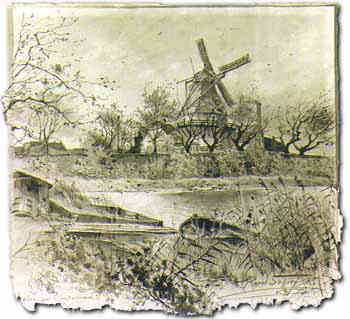 Back then, the ramparts had fresh air around them, as there were no tall buildings in Christianshavn. Nor did trees grow on the ramparts, as we know them today. Therefore, it was obvious to exploit the wind power on the high ramparts. In 1890, the mill ground for the last time, and in 1897 the sails were removed. Unfortunately, the mill cap also disappeared, and the mill instead got the more flat roof. That was the mill story, but fortunately the remains of the mill and the mill farm remained.
Until 1918, the mill functioned for a time as a military straw depot, but in 1918 the enterprising South Jutland engineer E.F. Bundgaard took over the house and set up a home and instrument and apparatus factory here. Upon the death of the engineer and his wife, the whole glory was bequeathed to
the National Museum - including the complete interior from Bundgaard's home. The home and the rooms are still waiting to be opened as an intimate museum - just like the National Museum's antique-filled apartment in the city. The mill and the mill farm are today listed and owned by the National Museum. In fact, the mill farm functions as the official residence of the Director General of the National Heritage Agency - the Director General is the top manager at the National Museum.
In 1889, the mill had a larger neighbor - Christianshavn's Gasworks, a beautiful gas tank like the one we know as a theater building on Østerbro today. It was designed by Ludvig Fenger, but was torn down in 1948. Annoying enough, one dares to say today. In the same area there was also a poor cemetery for a period.
Christianshavn Canal
Christianshavn is often called "The Amsterdam of Copenhagen", it is here that there is a concentrated canal atmosphere. Christianshavn Canal is one of the three canals that remain in inner Copenhagen, and then we do not count Holmen's canals between Christiansholm, Arsenaløen, Dokøen, Frederiksholm and Nyholm.
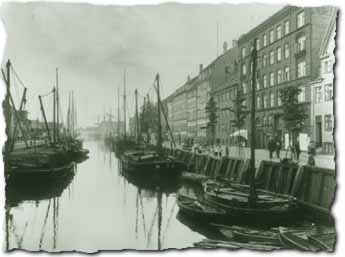 The rest has unfortunately disappeared, for example Holmen's canal, which is filled with stones and gravel and asphalted. But it could be changed just like in Aarhus, where the stream has wisely been reopened.
Between the harbor and Christianshavn Canal lies the two parts of Christianshavn, which are actually islands or islets, with i.a. Wilders Plads and Greenlandic Trading Place - here we have the beautiful churches Christianshavn Church and Our Savior's Church. Christianshavn Canal with Ovengaden oven Vandet and Ovengaden neden Vandet on each side is an extremely atmospheric canal, which is used as a common front garden by everyone from the adjacent streets. Here you go down with your sweetheart or the dog, with the thermos, the beer bottle - on warm summer evenings also with dinner. Here are pleasure boats in abundance, here is a wealth of experiences.
Out to the canal itself lies i.a. Holmen's beautiful arsenal building from the mid-1700s, Søkvæsthuset (Holmen's hospital or infirmary), here lay the former Wildersgade barracks, today converted into cooperative apartments, and close by were two other barracks - Bådsmandsstrædes Kaserne and the barracks out to Strandgade, which today is called Irgens Gård.
Copenhagen's Women's Prison was located where the layer cake house out to Christianshavn's Torv is today. There is serving on the water in the corner by Torvegade, in the same place there is cozy boat rental, and at the end towards Appelbys Plads you can see a stump of Christianshavn's Vold.
Christianshavn Canal is one of the city's most charming places, which should be experienced both from the quay and from the water. A canal tour is absolutely recommended.
Carlsberg delivers the beer
Ravelinen is just the place for a refreshing beer - not least outdoors in the summer heat.
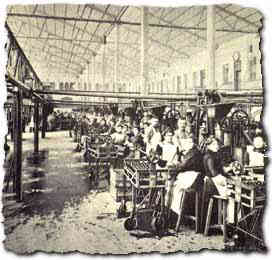 The beer comes from the world-famous Carlsberg, which many of us had the opportunity to get to know better through TV's large-scale series "The Brewer". The beer production started in Brolæggerstræde, here it was white beer that was the thing.
The man behind the name Carlsberg was brewer J.C. Jacobsen who moved the brewery to Valby Bakke and named it after his son Carl. Production started here in 1847. The brewery was later named Gamle Carlsberg, because the son started his own Ny Carlsberg Brewery. Today, the old plant from the 1840s is an industrial history museum.
Both J.C. and Carl Jacobsen were very interested in art and culture, which their large industrial plant with, among other things, the Elephant Gate on Valby hill testifies to. Carl Jacobsen established the country's first glyptotheque, which today functions as the Carlsberg Museum. The same Carl established and gave the city of Copenhagen what we today know as the wonderful Ny Carlsberg Glyptotek. The Glyptoteket is a unique museum, next to Tivoli and with entrance from H.C. Andersens Boulevard.
From Carlsberg, the city has also received a myriad of monuments and buildings as a gift. These include the greenhouses in the Botanical Garden, the tower on Nikolaj Church and the building of the Academy of Sciences opposite Ny Carlsberg Glyptotek. And not least The Little Mermaid from 1913 by Langelinie. The Little Mermaid has become our national symbol. You cannot visit Copenhagen without seeing her or having your picture taken with her, just as you cannot be expected to visit New York without seeing the Statue of Liberty.
Also the reconstruction of Frederiksborg Castle in Hillerød is a gift from Carlsberg, which is both the past and present's great art patron. One of the main architects behind Carlsberg's diligent construction activities around was Vilhelm Dahlerup, whom we also know from The Royal Theatre, the Pantomime Theatre in Tivoli and the Søpavillonen.
Peter Olesen, journalist and author